How Virtual Reality Is Reshaping Sports Training and Transforming the Fan Experience

VR Enters the Arena: A New Era for Sports Technology
Virtual reality has moved well past the experimental phase in sports — it is now an active part of how elite athletes prepare and how fans consume the games they love. What started as a novelty has become a legitimate performance and engagement tool adopted by franchises across the NFL, NBA, Premier League, and beyond.
The shift is significant because VR addresses two separate but equally important challenges in modern sports: how to train more effectively without increasing physical risk, and how to keep fans connected to the action in an era of shrinking attention spans and rising broadcast competition. Both problems have the same solution sitting inside a head-mounted display.
Extended Reality (XR) — the umbrella term covering VR, augmented reality, and mixed reality — is reshaping the infrastructure of competitive sport. Teams that once relied on film sessions and whiteboard tactics are now putting players inside simulated game environments before they ever step onto a real field.
Inside the Headset: How Athletes Are Using VR to Train Smarter
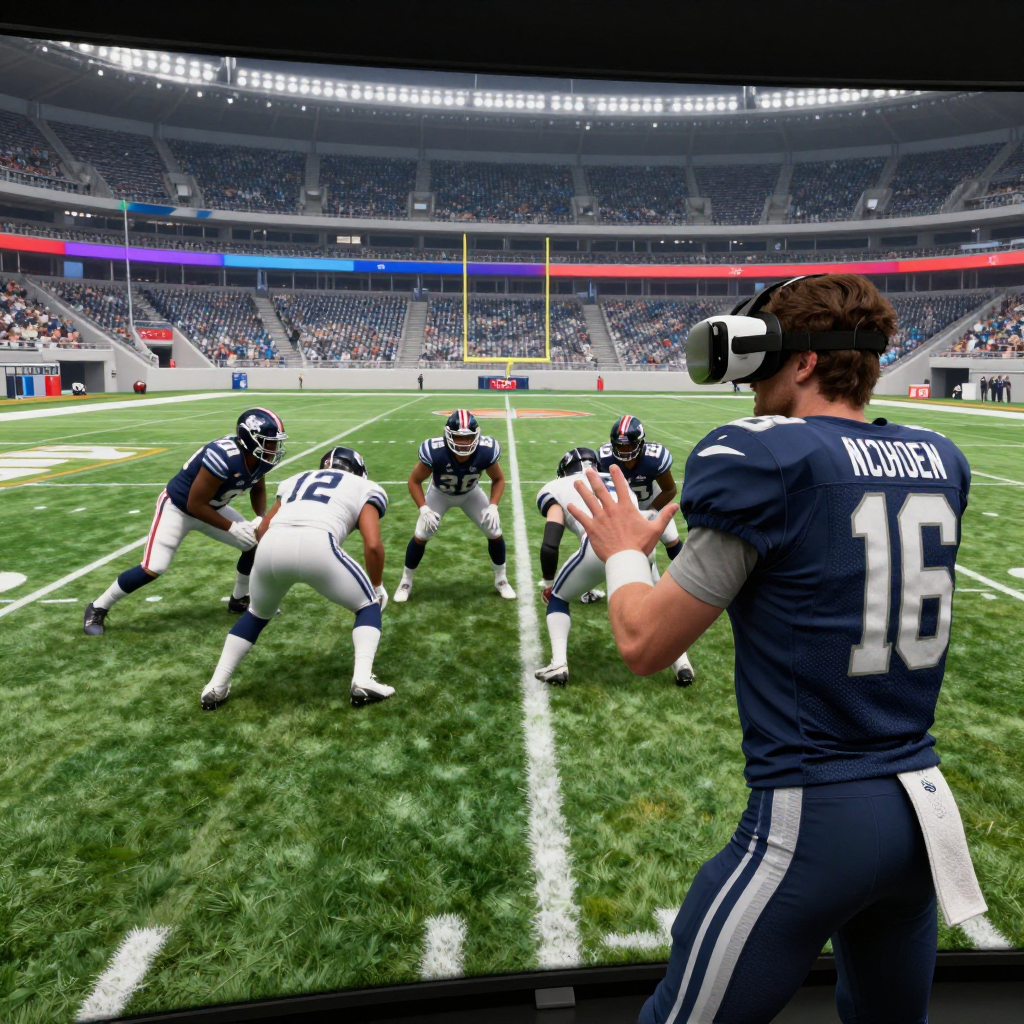
Athletes use VR primarily for cognitive training, play visualization, and high-repetition practice without the physical wear that comes with live drills. A quarterback can run through hundreds of defensive reads in a single session. A goalkeeper can face penalty scenarios until pattern recognition becomes instinctual.
The core advantage of immersive training simulations is that they compress time. Traditional practice is limited by field availability, weather, team schedules, and the physical capacity of players. VR removes most of those constraints. A receiver recovering from a hamstring injury can still work on route timing. A basketball point guard can study defensive rotations from inside the play rather than watching it on a flat screen.
Reaction time and cognitive training are where VR shows its clearest measurable gains. Platforms like STRIVR (used by NFL teams and NBA franchises) place athletes in realistic game situations where split-second decisions must be made under simulated pressure. The brain doesn't fully distinguish between a vivid virtual environment and a real one — which is exactly what makes the training transfer to actual competition.
Youth and amateur athletes are beginning to access scaled-down versions of these tools as hardware costs drop. What was once exclusive to professional franchises with seven-figure technology budgets is gradually becoming available to college programs and even serious high school athletes.
Performance Analytics Meets Immersive Simulation
VR becomes significantly more powerful when it is paired with athlete performance analytics. Standalone simulation is useful, but simulation that records eye movement, decision latency, body positioning, and response accuracy gives coaches a data layer that traditional practice never could.
Modern VR training systems integrate motion tracking sensors with HMDs to capture biomechanical data during simulated reps. A coach can see not just whether a player made the right read, but how long it took, where their eyes went first, and whether their body mechanics matched the decision. That granularity changes how feedback is delivered and how quickly players correct errors.
The combination also enables personalized training loads. Instead of running the whole team through the same drill, a coaching staff can identify which players struggle with specific defensive schemes or spatial awareness tasks and assign targeted VR sessions. This is the kind of individualization that was theoretically desirable but practically impossible at scale before immersive simulation existed.
Some professional leagues are exploring how VR-generated performance data can complement existing sports science metrics — pairing cognitive response data from virtual environments with GPS load data and biometric recovery markers from wearables. The integration is still evolving, but the direction is clear: VR is becoming a data collection environment, not just a visualization tool.
From the Sidelines to the Center: VR and the Evolution of Fan Engagement
For fans, VR offers something broadcast television fundamentally cannot: the ability to choose your own perspective. 360-degree live streaming lets viewers sit virtually courtside at an NBA game, stand in the tunnel as teams walk out, or watch a Champions League match from behind the goal line.
Several major leagues have experimented with virtual courtside seats and immersive highlight packages delivered through consumer HMDs. The appeal is obvious — particularly for fans who cannot afford premium seating or who live far from their team's home city. A supporter in Tokyo can experience a live match in Manchester with a spatial presence that a traditional broadcast simply doesn't replicate.
Fan engagement technology in VR is still developing its commercial model. Current experiences vary in quality depending on the streaming infrastructure, the headset used, and the production investment from the league or broadcaster. Some experiences feel genuinely immersive; others feel like a 360-degree video with limited interactivity. The gap between the best and average implementations is wide.
Where the technology is heading is toward social VR viewing — shared virtual spaces where fans can watch games together, interact with real-time statistics overlaid on the field, and access exclusive content that isn't available through any other medium. That vision is still a few years from mainstream delivery, but the foundation is being built now.
Where Sports and Esports Converge in Virtual Space
The crossover between VR sports training and the esports ecosystem is more natural than it might initially appear. Esports athletes already train in digital environments, analyze performance through data dashboards, and compete in front of audiences who watch through screens rather than in person. VR extends that logic into physical sports while simultaneously giving esports a new competitive frontier.
VR esports titles — where players compete inside fully immersive virtual environments — are growing as a distinct competitive category. Games like Eleven Table Tennis VR and Racket: Nx require genuine physical athleticism, blurring the line between traditional sport and digital competition. Meanwhile, traditional sports franchises are investing in esports divisions that use VR-based training tools similar to those their physical rosters use.
For a sports and esports audience, this convergence matters because it suggests a shared future rather than two separate lanes. The cognitive skills developed in esports — rapid decision-making, spatial awareness, pattern recognition under pressure — are the same skills VR training targets in physical athletes. The tools are becoming interchangeable in ways that neither community fully anticipated.
Challenges and Barriers to Widespread VR Adoption in Sports
VR in sports is promising, but adoption is selective and uneven — and that needs to be stated plainly. Several real barriers slow the technology from becoming standard practice across all levels of sport.
Cost remains the most immediate obstacle. Enterprise-grade VR training systems with full analytics integration can cost hundreds of thousands of dollars to implement, which limits access to well-funded professional franchises. Consumer HMDs have dropped in price significantly, but the content and infrastructure required for meaningful sports training or high-quality fan experiences adds layers of expense.
Hardware limitations also matter. Current headsets can cause motion sickness in some users during fast-movement simulations, latency issues can disrupt the sense of presence, and resolution — while improving — still falls short of the visual fidelity athletes need for precise spatial training in some scenarios.
There is also institutional resistance. Traditional coaching cultures in many sports are skeptical of technology that hasn't been validated across decades of use. Convincing a veteran coach that a quarterback's VR reps are as valuable as live practice reps requires evidence that takes time to accumulate. Some franchises that invested early in VR training reported mixed results when implementation wasn't paired with proper coaching integration.
What's Next: The Future of VR in Sports and Fan Culture
The next wave of VR in sports will be defined by full-body haptic feedback, social viewing environments, and deeper league-level integration. Haptic suits that let athletes feel simulated contact during VR drills are already in early development, which would address one of the most significant gaps in current immersive training — the absence of physical sensation.
On the fan side, social VR platforms are building toward experiences where attending a virtual game feels genuinely communal rather than isolating. The ability to share a virtual space with other fans, react in real time, and access data overlays that personalize the viewing experience could eventually make VR a preferred format for certain types of sporting events — particularly for global audiences who lack geographic access to live venues.
League-level VR integration is the milestone that will signal true mainstream arrival. When a major professional league builds VR into its official broadcast package — not as an experiment but as a standard offering — the technology will have crossed from early adoption into cultural infrastructure. Several leagues are moving in that direction, though the timeline remains uncertain.
The broader trajectory is clear: virtual reality is not replacing the live sports experience or the physical demands of athletic training. It is adding a layer that neither could previously access — immersive, data-rich, and scalable in ways that traditional methods are not.
Frequently Asked Questions
What sports currently use VR most extensively in training?
American football, basketball, and soccer lead VR training adoption at the professional level. NFL teams have used platforms like STRIVR for quarterback and defensive back training since the mid-2010s. NBA franchises use immersive simulation for play recognition and spatial awareness. Baseball and hockey programs are also developing VR applications for pitch recognition and goaltender training respectively.
Can amateur or youth athletes benefit from VR training tools?
Yes, though the tools available at that level are less sophisticated than professional systems. Consumer VR headsets paired with sport-specific training apps offer genuine cognitive and visualization benefits for youth athletes. The cost barrier has dropped enough that some college programs and well-resourced high school teams are incorporating basic VR drills into their training rotations.
How does VR fan experience differ from traditional broadcast viewing?
Traditional broadcasts offer a fixed, director-controlled perspective. VR fan experiences give viewers spatial agency — the ability to choose their vantage point, look around the venue, and in some implementations, access real-time statistics overlaid on the field of play. The sense of presence is fundamentally different, though current technology doesn't yet fully replicate the atmosphere of being physically in a stadium.
Is VR in sports connected to the growth of esports?
The connection is real and growing. Both domains rely on digital environments, performance data, and remote audience engagement. VR training tools developed for physical athletes are conceptually aligned with how esports athletes already train. Meanwhile, VR esports as a competitive category is expanding, creating a space where the distinction between physical and digital sport becomes genuinely blurred.
What equipment do fans need to access VR sports experiences?
At minimum, a standalone VR headset such as the Meta Quest series provides access to most consumer VR sports content. Some 360-degree streaming experiences can be viewed through smartphone-based cardboard viewers, though the quality is significantly lower. For the highest-fidelity experiences — particularly social VR viewing platforms — a dedicated headset with a reliable internet connection is the practical baseline.